
Dopamine-Menu Parenting: How to Stop Fighting Boredom and Start Fueling Your Child's Focus
Published by The Able Blog | Date: 2026-08-24
TL;DR
- The Neurobiology of ADHD: Children with ADHD experience a chronic dopamine deficit, making low-stimulation tasks like homework or transitions feel physically painful and difficult to initiate.
- The Concept: A "Dopamine Menu" provides a visual, child-friendly list of healthy, self-directed activities categorized by effort and reward, eliminating constant power struggles over screen time and boredom.
- The Execution: By dividing activities into "Appetizers," "Entrees," "Sides," and "Specials," parents empower kids aged 4–12 to independently regulate their energy levels and bridge the gap between under-stimulation and focus.
The ADHD Brain and the Boredom Crisis
Picture this: It is 4:30 PM on a Tuesday. Homework sits untouched on the kitchen table, your seven-year-old is lying face-down on the rug groaning that they are "dying of boredom," and the television remote is the center of a high-stakes geopolitical negotiation. If you try to enforce a screen-free rule, an explosion follows. If you hand over the tablet, you trigger a brutal meltdown when it is time to turn it off.
As a pediatric clinician, I hear this exact loop from families every single day. Parents often interpret this cycle as defiance, laziness, or screen addiction. But in clinical reality, we are looking at an executive function crisis driven by neurobiology.
Why "I'm Bored" Hurts the ADHD Nervous System
The neurodivergent brain operates with dysregulated dopamine pathways. Dopamine is not just the "pleasure molecule"; it is the neurotransmitter of motivation, saliency, and movement. It is the chemical spark that whispers to the brain, "This task matters, do it now."
For a child with ADHD, the baseline level of dopamine is chronically under-supplied, and the receptors are less efficient at processing what is available. When faced with a "low-dopamine" task—like brushing teeth, packing a backpack, or sitting quietly—the ADHD brain experiences a sensation akin to physical starvation. It screams for stimulation.
When parents default to telling a child to "just go play" without scaffolding, the child's brain remains paralyzed in an under-stimulated state. They cannot bridge the gap between doing nothing and doing something productive. They need an external scaffold to help them navigate their internal state. They need a menu.
Building Your Family’s Dopamine Menu
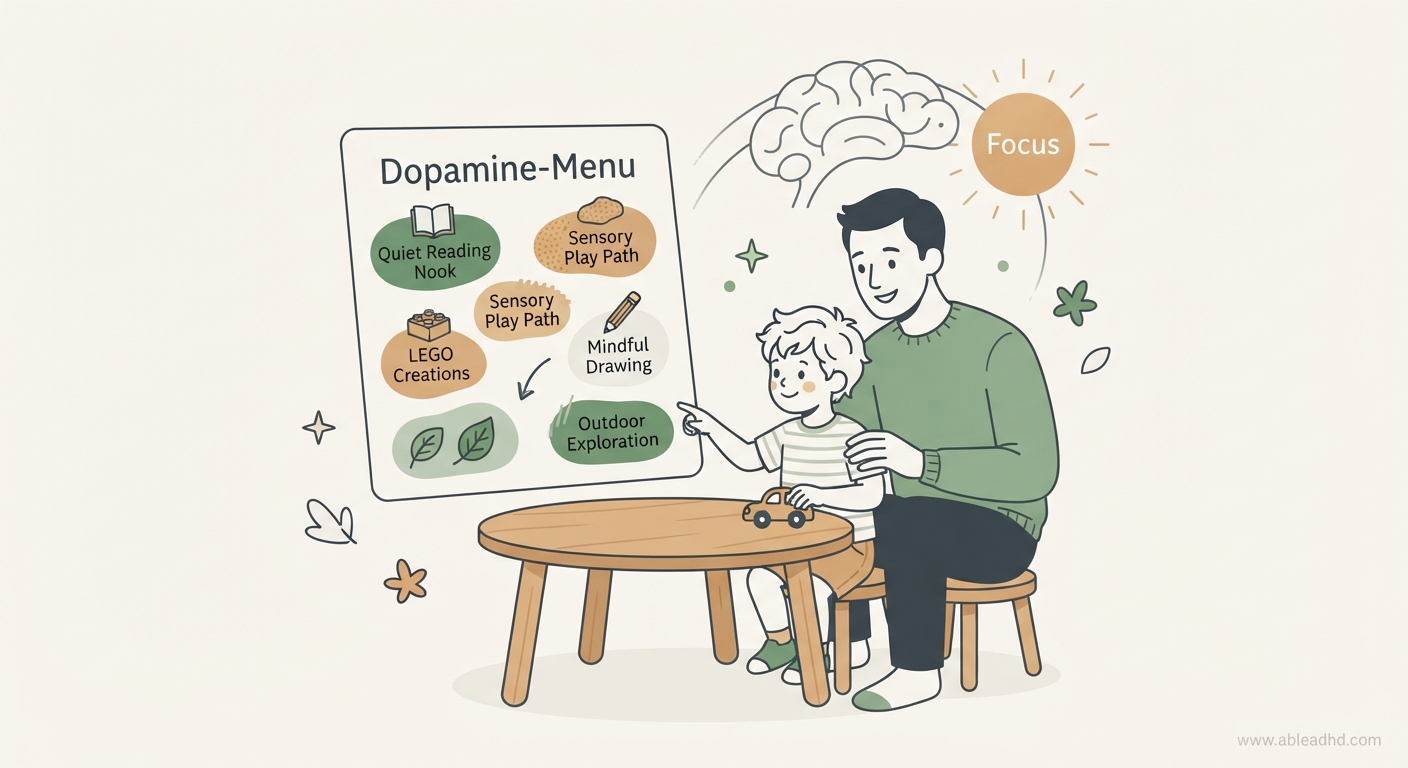
Rooted in occupational therapy and cognitive behavioral principles, a Dopamine Menu is a visual, personalized catalog of healthy activities categorized by how much effort they require and how much dopamine they yield. Instead of a parent acting as the endless entertainment director—or the strict warden banning screens—the child learns to look at their menu, assess their internal energy, and make an independent choice.
When designing a menu for children aged 4 to 12, keep the language playful and relatable. Use a real restaurant menu template, laminate it, and hang it on the refrigerator or a playroom wall.
+-------------------------------------------------------+
|                 THE BRAIN-FUEL CAFE                   |
+-------------------------------------------------------+
| APPETIZERS (Quick 2-Minute Boosts)                    |
| • 10 wall pushes        • Drink ice-cold water        |
| • Sing one loud song    • Pet the dog                 |
+-------------------------------------------------------+
| ENTREES (Deep Focus & Flow States)                    |
| • LEGO building         • Painting a picture          |
| • Fort building         • Baking with supervision     |
+-------------------------------------------------------+
| SIDES (Background Stimulation)                        |
| • Listening to an audio-book • Instrumental jazz      |
+-------------------------------------------------------+
| SPECIALS (High Effort / High Reward - Limit Use)      |
| • Video game time (30 min) • Bicycle ride outside     |
+-------------------------------------------------------+
Categorizing the Options for Maximum Success
To make the menu truly functional, structure it using four distinct courses:
- Appetizers (Quick Fixes / 2–5 minutes): These are micro-doses of dopamine designed to snap a child out of inertia or emotional dysregulation. They involve proprioceptive or vestibular input that wakes up the nervous system. Think: doing ten wall pushes, drinking a glass of ice-cold water with a straw, spinning in an office chair, or jumping on a mini-trampoline.
- Entrees (Substantial Tasks / 15–45 minutes): These are engaging, hands-on activities that capture interest and build a flow state. They require a bit more setup but sustain attention longer. Examples include building a complex LEGO set, painting a canvas, crafting with cardboard and duct tape, or playing an active imaginative game.
- Sides (Accompaniments): These are sensory supports that can be paired with boring tasks to make them tolerable. For instance, listening to an upbeat playlist or an audiobook while folding laundry or cleaning a bedroom.
- Specials (High-Reward Activities): This is where screen time, complex baking projects, or trips to the park live. These require parental facilitation or strict time boundaries. Crucially, by placing screens on the menu alongside other high-reward options, we de-escalate the emotional charge around devices. Screen time is no longer a forbidden fruit; it is simply the "steak dinner" of the menu—enjoyed intentionally, not automatically.
Guiding Independent Transitions and Lowering Friction
Creating the menu is only step one. The true clinical magic happens in how you coach your child to use it. Children with ADHD struggle heavily with working memory and state-switching; asking them to "go pick something from your menu" when they are already dysregulated will often fail.
Step-by-Step Implementation Coaching
- Collaborative Creation: Never write the menu in isolation. Sit down with your child during a calm moment (not during a meltdown) and brainstorm together. Ask questions like: “What is a quick thing that wakes your brain up when you feel sleepy?” or “What activity makes you lose track of time?”
- Externalize the Check-In: Teach your child to name their current state using a physical scale, such as an "Engine Speed" metaphor (Fast/Revving, Just Right, or Sluggish/Stalled).
- Bridge the Gap: When your child says, "I'm bored," resist the urge to solve the problem for them. Instead, point to the menu and offer a scaffolded choice. Say: "I notice your engine is running a bit sluggish. Let’s look at the Appetizer section together. Do you want to do ten jumping jacks or drink a sour lemon drop?"
- Use Visual Timers for Specials: When pulling a high-dopamine item from the "Specials" category (like a video game), pair it explicitly with a visual countdown timer (such as a Time Timer). Pre-warn the transition: "When the red disk disappears, we are transitioning to an Appetizer activity to help our brain wind down."
By shifting the dynamic from parental policing to self-directed menu selection, you teach children with ADHD the lifelong metacognitive skill of emotional regulation. You validate their biological need for stimulation while giving them the healthy tools to fuel their own focus.
References
- Barkley, R. A. (2015). Attention-Deficit Hyperactivity Disorder: A Handbook for Diagnosis and Treatment (4th ed.). Guilford Press.
- Hallowell, E. M., & Ratey, J. J. (2021). ADHD 2.0: New Science and Essential Strategies for Thriving with Distraction—From Childhood Through Adulthood. Ballantine Books.
- Ayres, A. J. (2005). Sensory Integration and the Child: Understanding Hidden Sensory Challenges. Western Psychological Services.
Tired of explaining your child’s ADHD to every teacher?
Upload your clinical diagnosis report and instantly generate a one-page, teacher-ready brief with evidence-based strategies in 2 minutes.
Create Your Free Teacher Brief →