
Morning Routine Meltdowns: How We Survived Getting a 6-Year-Old Out the Door
Published by The Able Blog | Date: 2026-08-18
TL;DR
- The Reality: Mornings with a 6-year-old ADHD child often feel like disarming a bomb. Yelling makes it explode.
- The Shift: Stop managing time; manage transitions and physical friction.
- The Takeaway: Use single, visible cues instead of abstract commands.
The 7:15 AM Warzone
My son is six. Last Tuesday, he stood in front of his socks for twelve minutes, completely paralyzed. The clock was ticking toward the school bus deadline. My pulse was spiking.
The old instinct—the one drilled into every parent by polite society—was to raise my voice: "Hurry up! Put your socks on right now!"
Shouting does not accelerate an ADHD brain. It adds noise to an already overloaded nervous system. When working memory is flooded, words become background static.
Why Abstract Commands Fail
Children aged 5 to 10 with ADHD do not lack compliance; they lack executive bandwidth. Telling a 6-year-old to "get ready" is like giving instructions in Ancient Greek.
What Actually Works:
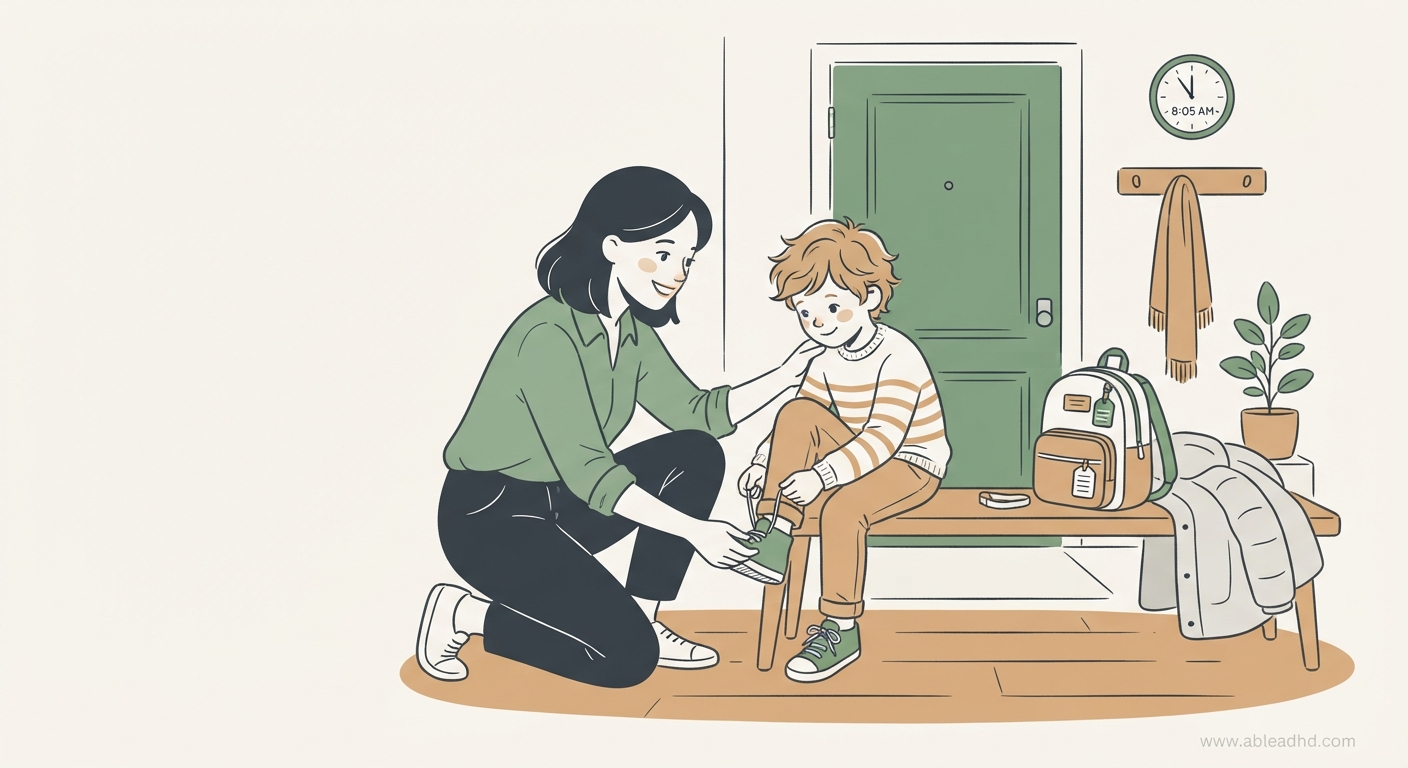
- Remove choices: Do not ask what they want to wear. Hand over the blue shirt.
- Micro-steps: Break dressing down into single physical actions.
- Body doubling: Sit on the floor beside them. Your calm nervous system regulates theirs.
Closing the Gap Between Intention and Action
Parenting an ADHD child demands that we abandon perfectionism. Some mornings will still end in tears. But when we stop fighting our children's neurobiology and start structuring their environment, the friction drops.
References
- Barkley, R. A. (2020). Taking Charge of ADHD: The Complete, Authoritative Guide for Parents (4th ed.). Guilford Press.
- Centers for Disease Control and Prevention. (2024). Behavioral Therapy for Children with ADHD. U.S. Department of Health and Human Services.
- American Academy of Pediatrics. (2019). Clinical Practice Guideline for the Diagnosis, Evaluation, and Treatment of Attention-Deficit/Hyperactivity Disorder in Children and Adolescents. Pediatrics, 144(4), e20192528.
Tired of explaining your child’s ADHD to every teacher?
Upload your clinical diagnosis report and instantly generate a one-page, teacher-ready brief with evidence-based strategies in 2 minutes.
Create Your Free Teacher Brief →