
Playground Politics: How to Help Your ADHD Child Navigate Big Feelings and Rejection Sensitivity
Published by The Able Blog | Date: 2026-08-20
TL;DR
- Decode the Subtext: Kids with ADHD often miss subtle social cues, making structured playdates and clear expectations essential for building peer connections.
- Understand Rejection Sensitive Dysphoria (RSD): Intense emotional outbursts over perceived slights are rooted in real neurological pain, not behavioral defiance.
- Practice Proactive Coaching: Use role-play and "post-game debriefs" at home to teach emotional regulation and problem-solving before the next recess.
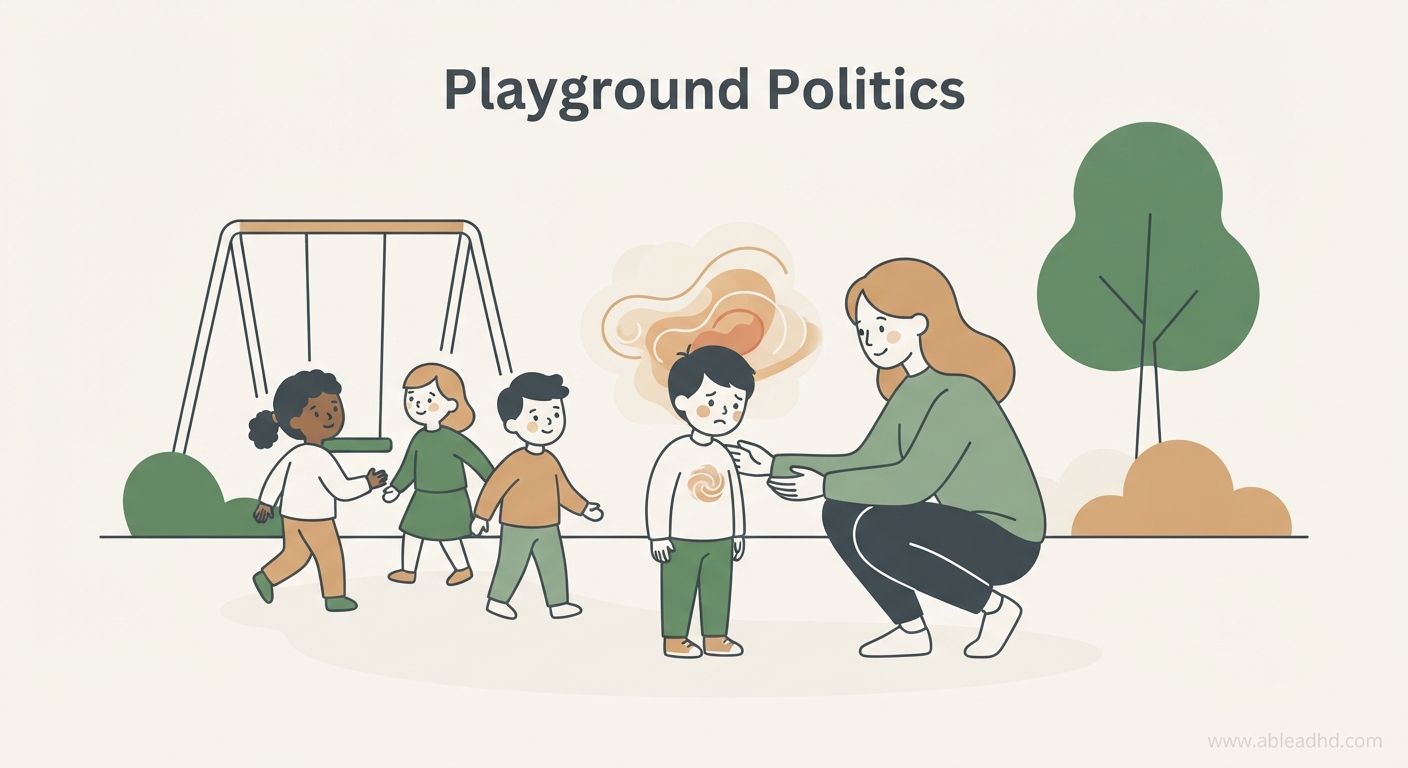
For an elementary-aged child with ADHD, the school playground is rarely just a place for fun and games. It is a high-speed, unstructured social arena governed by unwritten rules, rapid shifts in allegiance, and subtle non-verbal cues. When your child comes home in tears because "nobody wanted to play," it breaks your heart. Even more challenging is when a minor exclusion triggers a full-blown meltdown, leaving you wondering how a simple game of tag turned into a crisis.
Navigating these social hurdles requires understanding the neurological mechanics behind how children with ADHD process peer interactions. By shifting our perspective from behavior management to empathetic coaching, we can help our children build resilience and lasting friendships.
Decoding Social Cues and the ADHD Brain
The Challenge of Rapid-Fire Social Dynamics
Friendships in elementary school rely heavily on executive functioning: working memory, impulse control, and emotional self-regulation. Children with ADHD often struggle to read the room in fast-paced environments. They might interrupt a game, miss a peer's subtle body language indicating boredom, or dominate a conversation without realizing it.
When these missteps happen repeatedly, peers may pull away, leaving the ADHD child confused and hurt. They rarely intend to be intrusive; their brains are simply managing a flood of sensory and social input all at once.
Practical Strategies for Social Decoding
- Structure the Environment: Opt for playdates with clear, structured activities (like board games, building with LEGO blocks, or organized craft projects) rather than open-ended "go play" scenarios. Structure reduces the cognitive load of figuring out what to do next.
- Narrate Social Cues: While watching a movie or sitting at a park together, gently point out social dynamics. Say, "Notice how that boy crossed his arms and looked away? That’s a sign he wants some space right now." Doing this in a low-stakes environment builds observational skills.
- Pre-Game Reminders: Before entering a social gathering, review one or two specific goals. Keep it positive: "Remember to ask what game the group is already playing before you jump in."
Managing Big Feelings and Rejection Sensitivity
Understanding the Pain of RSD
When an ADHD child experiences social rejection, the emotional fallout can be devastating. Many children experience Rejection Sensitive Dysphoria (RSD)—a sudden, intense wave of emotional pain triggered by the perception (real or imagined) of rejection, teasing, or criticism.
To a parent, a child's reaction—screaming, withdrawing completely, or striking out in anger—might seem disproportionate to the event. However, neuroimaging studies show that emotional dysregulation is a core feature of ADHD. The pain they feel in that moment is neurologically real and overwhelming.
Actionable Steps for Emotional Regulation
- Validate Before You Correct: When your child is melting down over a playground slight, resist the urge to minimize it with phrases like "Oh, they didn't mean it" or "It's no big deal." Instead, validate the feeling first: "Your heart is hurting right now because you felt left out. That feels awful."
- Co-Regulate First: A dysregulated brain cannot process logic. Sit quietly with your child, offer a weighted blanket, or take slow, exaggerated breaths together until their nervous system returns to baseline.
- The "Post-Game" Debrief: Once your child is calm, review what happened using curiosity rather than judgment. Ask open-ended questions: "What was going through your head when Sarah ran away? What could we try differently next time?"
Building Resilience and Long-Term Connection
Friendship is a skill, just like reading or math. Children with ADHD often need explicit, repeated instruction in social problem-solving. Celebrate small victories—like the day your child successfully shared a toy or walked away from a negative interaction without escalating.
By acting as a patient coach rather than an enforcement officer, you give your child the tools to decode the complex world of playground politics and find peers who appreciate their unique, vibrant energy.
References
- Barkley, R. A. (2015). Attention-Deficit Hyperactivity Disorder: A Handbook for Diagnosis and Treatment (4th ed.). Guilford Press.
- Centers for Disease Control and Prevention (CDC). (2023). Symptoms and Diagnosis of ADHD in Children. U.S. Department of Health and Human Services.
- Dodson, W. W. (2017). Rejection Sensitive Dysphoria and ADHD. ADDitude Magazine.
Tired of explaining your child’s ADHD to every teacher?
Upload your clinical diagnosis report and instantly generate a one-page, teacher-ready brief with evidence-based strategies in 2 minutes.
Create Your Free Teacher Brief →