
The Birthday Party Minefield: How to Help Your ADHD Child Handle Sensory Overload and Social FOMO
Published by The Able Blog | Date: 2026-09-07
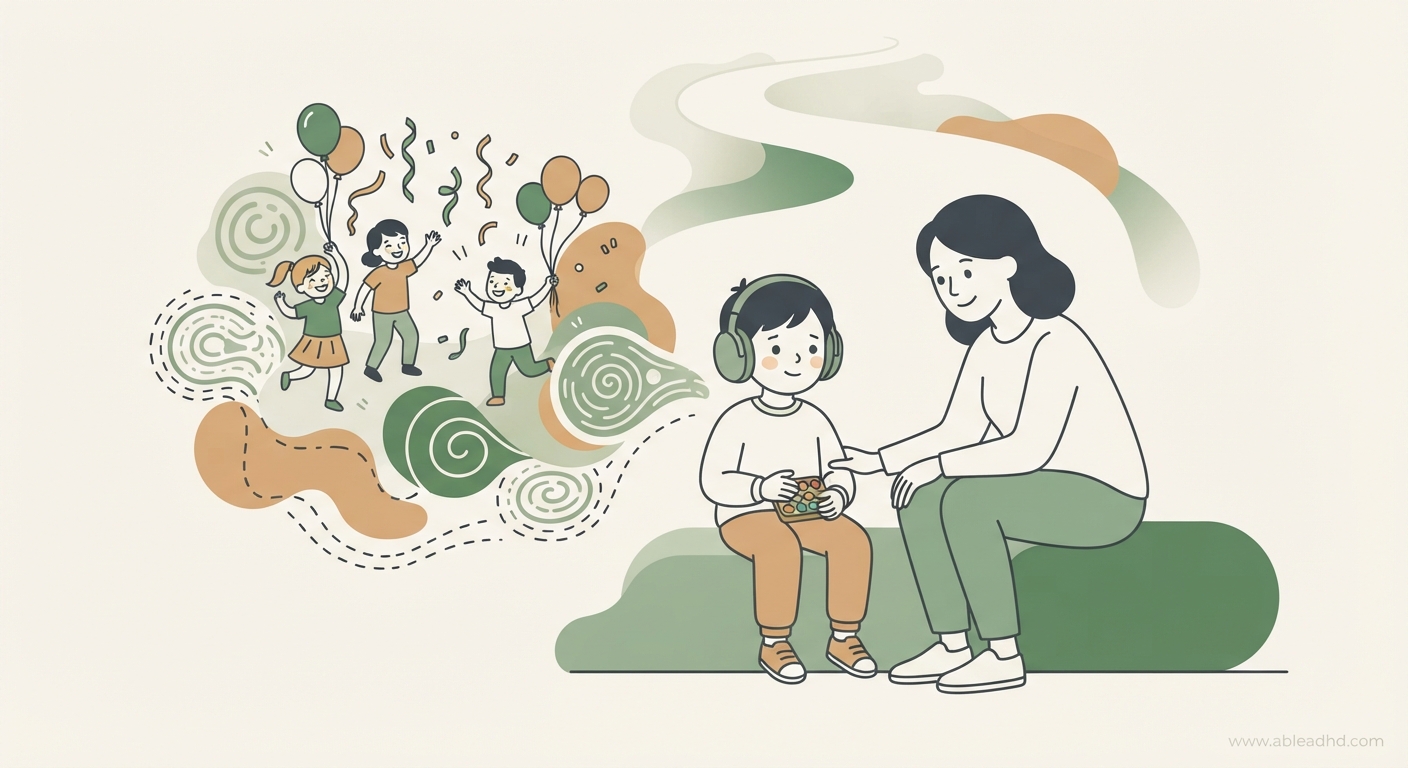
TL;DR
- The Dual Pull: ADHD children often experience an intense Fear Of Missing Out (FOMO) that drives them to attend loud, chaotic parties, immediately followed by severe sensory overload and emotional dysregulation.
- Proactive Pacing: Success relies on pre-teaching exit strategies, establishing a discrete "safe zone" or quiet escape plan, and managing the dopamine rollercoaster of unstructured play and sugar.
- Compassionate Boundaries: Parents can protect their child’s mental health by viewing meltdowns not as behavioral failures, but as biological exhaustion signals requiring immediate decompression.
The Perfect Storm: Why Birthday Parties Trigger ADHD Nervous Systems
To a child with Attention-Deficit/Hyperactivity Disorder (ADHD), a standard birthday party is not merely a social gathering—it is a sensory obstacle course designed to test every limit of their neurodevelopmental profile. Imagine walking into a gymnasium filled with thirty screaming children, pulsating music, flashing arcade lights, the smell of heavy pizza and synthetic frosting, and an unstructured timeline of activities. For a brain with an executive functioning deficit, filtering out background noise and regulating emotional impulses becomes nearly impossible.
Yet, despite knowing how difficult these environments are, many children with ADHD experience crushing social FOMO. They desperately want to belong, to be invited, and to partake in the fun. This creates an exhausting internal conflict: the fear of being excluded pushes them through the front door, while the overwhelming sensory input pushes their nervous system straight into fight-or-flight mode.
As a clinician, I frequently remind parents that a post-party meltdown is rarely about "bad behavior" or ingratitude. It is an exhaustion reflex. When dopamine stores are completely depleted from hours of masking, intense social navigation, and sensory processing overload, the child’s emotional regulatory system simply short-circuits.
Pre-Party Planning: Setting the Stage for Success
Managing a birthday party minefield starts long before you hand over a wrapped present at the venue door. Proactive scaffolding can dramatically lower anxiety and prevent escalation.
1. The Pre-Game Reality Check and Social Scripting
Before attending, sit down with your child in a calm environment to discuss the upcoming event. Avoid vague statements like "just be good." Instead, use concrete social scripting and collaborative problem-solving.
- Review the timeline: Outline what will happen first (e.g., eating pizza), second (games), and last (cake and presents).
- Set an exit strategy: Agree on a secret hand signal or code word that your child can use when they feel the internal pressure building. Make a mutual promise that if they use the word, you will take a break or leave without judgment.
2. Crafting an On-Site "Escape Plan"
Reach out to the host parent discretely before the party. A simple text explaining that your child has sensory sensitivities goes a long way.
- Identify a quiet zone at the venue—a parked car, a quiet hallway, or an outdoor patio—where your child can decompress for ten minutes without feeling trapped.
- Pack a sensory toolkit: noise-canceling headphones, a favorite discreet fidget toy, and a protein-rich snack to help stabilize blood sugar levels before the cake is served.
Navigating the Chaos: Managing Stimulation and Sugar in Real-Time
Once inside the party, the primary clinical challenge shifts from preparation to real-time mediation. Unstructured group games, such as "Pin the Tail on the Donkey" or chaotic tag, often trigger rejection-sensitive dysphoria (RSD) or impulsive reactions if rules feel unclear or unfair.
3. Supporting Emotional Regulation During Unstructured Play
ADHD brains crave high stimulation, which party games provide, but they also struggle significantly with impulse control and waiting turns.
- Stay within visual range: Position yourself where your child can see you, providing a non-verbal anchor of safety.
- Help reframe competitive pressure: If a game becomes too intense or your child feels excluded, step in naturally to pivot them toward a parallel activity, such as helping the parent prep juice boxes or checking out the birthday decorations.
4. Mitigating the Sugar and Dopamine Rollercoaster
The combination of artificial dyes, simple carbohydrates, and intense peer excitement acts like rocket fuel for an ADHD nervous system. While you cannot police every bite of birthday cake, you can buffer its impact.
- Feed your child a balanced meal containing protein and healthy fats before you arrive. A full stomach slows down the rapid absorption of sugar.
- Keep a water bottle on hand. Dehydration significantly amplifies irritability and cognitive fatigue in neurodivergent children.
The Post-Party Landing: Safe Decompression
The party is over, gifts are loaded into the car, and silence falls. This is often the exact moment the emotional dam breaks. Recognizing that the transition home requires just as much care as the party itself is crucial for family harmony.
Allow for a low-stimulus wind-down period. Turn off the car radio, dim the lights at home, and avoid interrogating your child with questions like, "Did you have fun?" or "Why did you yell at Timmy?" Instead, offer quiet presence, validate their exhaustion, and let their nervous system reset naturally. By shifting our parenting approach from reaction to anticipation, we can help our ADHD children navigate social milestones with confidence and emotional safety.
References
- Barkley, R. A. (2015). Attention-Deficit Hyperactivity Disorder: A Handbook for Diagnosis and Treatment (4th ed.). Guilford Press.
- Miller, L. J. (2006). Sensory Processing Challenges: Effective Clinical Treatment and Practical Strategies for Parents. WW Norton & Company.
- Hinshaw, S. P., & Stier, A. (2008). ADHD, controlled impulsivity, and the social dynamics of middle childhood. Journal of Clinical Child and Adolescent Psychology, 37(4), 812-825.
Tired of explaining your child’s ADHD to every teacher?
Upload your clinical diagnosis report and instantly generate a one-page, teacher-ready brief with evidence-based strategies in 2 minutes.
Create Your Free Teacher Brief →