
The Boredom Trap: Why 'Doing Nothing' Is Actually Painful for the ADHD Brain (and What to Do Instead)
Published by The Able Blog | Date: 2026-09-15
TL;DR
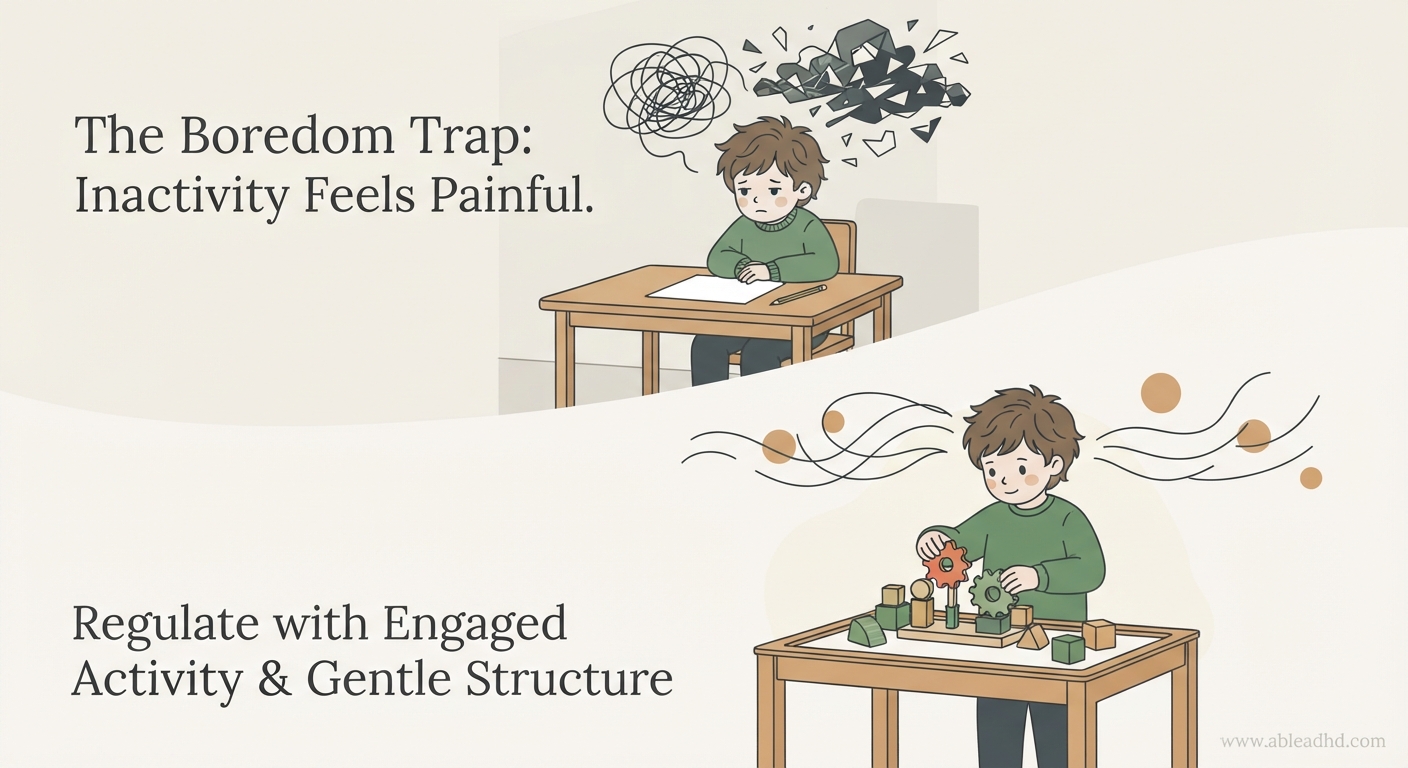
- Boredom is physical, not just emotional: For children with ADHD, under-stimulation literally feels painful and physically agitating due to low baseline dopamine.
- Chaos is a survival mechanism: When a room goes quiet, the ADHD brain manufactures its own stimulation—often through impulsive behavior, sibling provocation, or creating mess.
- Shift from punishment to provision: Instead of telling a child to "go sit quietly," parents can redirect under-stimulated energy using "high-yield" physical inputs and structured engagement tools.
The Neurological Reality of Under-Stimulation
Picture this: It is a quiet Sunday afternoon. You finally sit down with a cup of coffee, breathing a sigh of relief because the house is momentarily peaceful. Suddenly, a crash echoes from the hallway, followed immediately by your seven-year-old child shouting that their sibling took a plastic dinosaur. Within thirty seconds, calm has evaporated into a full-blown crisis over seemingly nothing.
If you are a parent of a child with Attention-Deficit/Hyperactivity Disorder (ADHD), this scenario is likely agonizingly familiar. Your first instinct may be to wonder why your child cannot simply sit still, relax, or enjoy a moment of peace.
To understand this behavior, we must reframe how we view boredom. For a neurotypical child, under-stimulation might feel mildly uncomfortable or uninspiring. For a child with ADHD, however, chronic under-arousal is a neurobiological state of distress.
The Dopamine Deficit and the Pain of Inaction
At the core of ADHD is a dysregulation of dopamine, the neurotransmitter responsible for motivation, reward, and the regulation of attention. Children with ADHD naturally produce less dopamine, or clear it from their neural synapses far too quickly.
When a neurotypical brain engages in a low-stimulation task—like waiting in line, riding in a car, or sitting in a quiet room—it can easily self-regulate and generate internal stimulation. The ADHD brain cannot do this efficiently. Without external input, the prefrontal cortex struggles to find traction.
Clinical research demonstrates that prolonged under-stimulation for an ADHD brain triggers physical symptoms: muscle restlessness, an intense craving for input, and emotional dysregulation. In functional neuroimaging studies, extreme boredom in individuals with ADHD actually lights up pain-processing regions of the brain. When your child says, "I'm bored, and it hurts," or acts out aggressively during quiet moments, they are not manipulating you. They are experiencing a visceral, physiological reaction to a starved nervous system.
Why the ADHD Brain Creates Chaos
When the nervous system is starved of stimulation, it goes on an urgent search-and-rescue mission. Because the brain requires arousal to function, it will take any stimulation it can get—even if that stimulation is negative.
This explains why an under-stimulated child will often:
- Provoke a sibling just to get a reaction.
- Intentionally break a rule to elicit an immediate (and highly stimulating) parental reprimand.
- Create physical chaos by climbing furniture, running down the hall, or dismantling toys.
In the mind of an ADHD child, getting yelled at for jumping on the couch is infinitely better than the agonizing void of doing nothing. Negative attention is still dopamine; chaos is still engagement. Recognizing this dynamic is a profound game-changer for parents. It shifts our perspective from "My child is being defiant" to "My child’s brain is screaming for fuel."
Practical Alternatives: How to Satisfy the Craving Without Driving Everyone Crazy
Fighting against your child's neurological need for stimulation is a losing battle. You cannot discipline a brain out of a dopamine deficit. Instead of punishing the symptom, we must change our approach by preemptively feeding the brain the right kind of input.
Here is how to safely satisfy your child's craving for mental and physical engagement before they manufacture their own chaos.
1. Build "High-Yield" Dopamine Speed Bumps
When you know your child is entering a low-stimulation window (such as homework time, riding in the car, or a rainy afternoon), build structural "speed bumps" into their routine that provide sensory and cognitive activation.
- Proprioceptive Inputs: Heavy work—like pushing a laundry basket, doing wall push-ups, or jumping on a mini-trampoline for two minutes—sends calming, organizing signals to the nervous system while burning off restless energy.
- Fidget Tools with a Purpose: Keep tactile tools nearby that require slight cognitive coordination, such as tangles, textured putty, or kinetic sand, which keep the hands busy while freeing up the listening brain.
2. Implement the "Novelty Swap"
The ADHD brain is uniquely wired to seek novelty. A toy or activity that was fascinating yesterday may hold zero neurochemical value today.
- Rotate your child’s toys, books, and independent activities every two weeks.
- Hide half of their play items in a closet and bring them back out later. The recycled novelty triggers a fresh wave of dopamine, making old items feel brand new and captivating.
3. Provide "Stimulation Snacks" Throughout the Day
Just as we feed our children physical snacks to prevent low blood sugar and meltdowns, we can feed their brains "stimulation snacks" to prevent under-arousal meltdowns.
- Set a visual timer for a 3-minute "brain break" every 20 minutes during sedentary tasks.
- During this break, let your child blast a favorite high-energy song, dance wildly, or do animal walks across the living room rug. Returning to the task afterwards is significantly easier because the nervous system's hunger has been safely satisfied.
By understanding that boredom is a physical pain point rather than a behavioral choice, we can stop fighting our children's biology and start partnering with it. When we provide structured, safe avenues for engagement, we rescue our children from the boredom trap—and restore a little peace to our homes.
References
- Barkley, R. A. (2015). Attention-Deficit Hyperactivity Disorder: A Handbook for Diagnosis and Treatment (4th ed.). Guilford Press.
- Volkow, N. D., Wang, G. J., Newcorn, J. H., Fowler, J. S., Telang, F., Maynard, M., ... & Logan, J. (2007). Depressed dopamine activity in caudate and occupancy of the dopamine transporter by therapeutic stimulant doses in ADHD. The American Journal of Psychiatry, 164(7), 1059–1068.
- Sonuga-Barke, E. J. S. (2003). The dual pathway model of AD/HD: An elaboration of neuro-developmental characteristics. Neuroscience & Biobehavioral Reviews, 27(7), 593–604.
Tired of explaining your child’s ADHD to every teacher?
Upload your clinical diagnosis report and instantly generate a one-page, teacher-ready brief with evidence-based strategies in 2 minutes.
Create Your Free Teacher Brief →