
The Family Board Game Trap: Why Traditional Rules Fail ADHD Kids (And How to Hack Them for Connection)
Published by The Able Blog | Date: 2026-09-21
TL;DR
- Traditional board game rules rely heavily on working memory, prolonged impulse control, and neurotypical emotional regulation, which can quickly trigger frustration and meltdowns in children with ADHD.
- Re-engineering game nights through rule hacks—such as cooperative play, eliminating rigid turn-taking, and shortening play loops—transforms a source of stress into an engine for joyful family connection.
- Shifting the goal of game night from winning to shared engagement protects self-esteem and builds essential executive function skills at a pace that honors the neurodivergent brain.
Inside the Mind on Game Night: Why the Rules Backfire
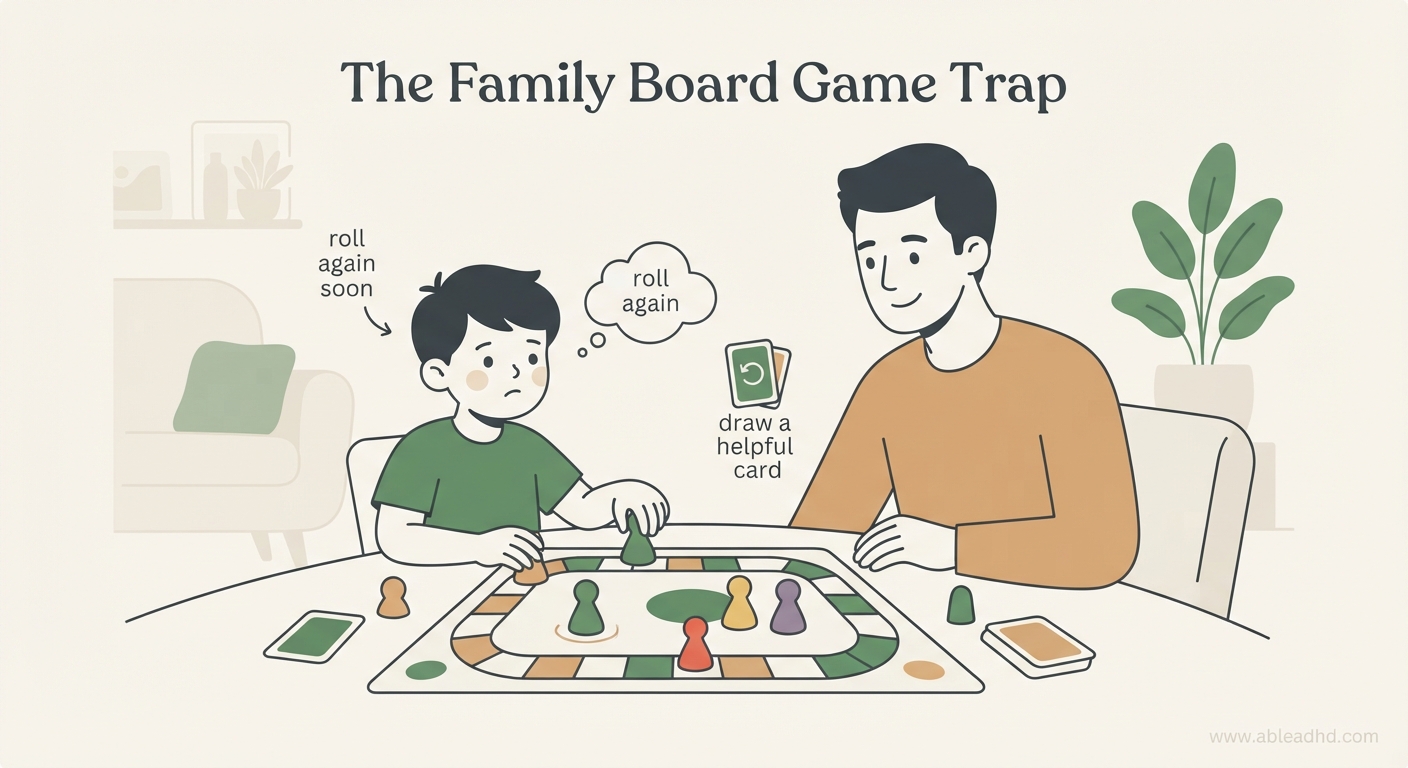
Picture the scene: It is Friday night. Pizza boxes are stacked on the counter, and you pull out a classic board game, hoping for an hour of wholesome family bonding. Within ten minutes, the board is askew, a sibling is crying, and your child with ADHD is either hiding under the kitchen table or aggressively declaring that the game is "stupid" and refusing to play ever again.
If this scenario feels painfully familiar, take a deep breath. You are not failing at parenting, and your child is not "defiant" or "bad a loser."
As a pediatric clinical expert who works daily with neurodivergent children and their families, I see this pattern constantly. We tend to view family game night as a neutral, lighthearted activity. However, from a neurological perspective, traditional board games are actually a gauntlet of executive function demands. To successfully play a standard, competitive, rule-bound board game, a child must deploy a massive array of cognitive skills that are fundamentally impacted by ADHD:
- Working Memory: Remembering complex, multi-step rules and tracking what other players are doing while waiting for their turn.
- Inhibitory Control: Sitting physically still, keeping hands to oneself, and suppressing the intense urge to blurt out moves or grab pieces out of turn.
- Emotional Regulation: Managing the dopamine crash of a sudden setback, processing the sting of losing, and hiding disappointment so as not to ruin the social environment.
When a child with ADHD experiences a meltdown over a game of Monopoly or Sorry!, their nervous system is not being manipulative. They are experiencing a true neurological bottleneck. Their prefrontal cortex—the CEO of the brain—is simply overwhelmed by the compounding demands of waiting, tracking, and emotional management.
The Neurodiversity-Affirming Blueprint: How to Hack the Rules
The solution is not to banish games from your home entirely, nor is it to force your child to "suck it up" and learn how the real world works through painful trial and error. The solution is to hack the game.
Neurodiversity-affirming parenting means adapting the environment to fit the child, rather than demanding the child contort themselves to fit a rigid, neurotypical standard. Here is how you can re-engineer your family game nights for low friction and high connection.
1. Ditch Turn-Taking and Embrace Co-op Play
Waiting for a turn is one of the most agonizing experiences for an ADHD brain. The internal clock stretches a thirty-second wait into what feels like an eternity, causing attention to wander, boredom to set in, and impulsive behavior to erupt.
- The Hack: Shift away from adversarial, competitive games where one person wins and everyone else loses. Instead, lean heavily into cooperative games (like Forbidden Island, Pandemic Junior, or Hoot Owl Hoot!) where the family works together against the board.
- The Modification: If you are playing a traditional game, fluidize the turns. Let players take actions simultaneously where possible, or act as a single team. For instance, pair your child with a parent or sibling as a "co-pilot" team. They can whisper strategies, share a hand of cards, and take turns executing actions together, cutting the waiting time in half and doubling the social support.
2. Shorten the Feedback Loop (Micro-Games)
Many classic games take forty-five minutes to an hour to finish. For a child with an underaroused dopamine system, that timeline is a recipe for complete disengagement.
- The Hack: Curate a library of "micro-games" that feature rapid-fire rounds, immediate physical action, and quick conclusions (think Dobble/Spot It!, Taco Cat Goat Cheese Pizza, Kingdomino, or Sleeping Queens).
- The Modification: If you love a longer game, create custom "checkpoint rules." Agree beforehand that the game ends after three rounds, and whoever has the most points at that specific, shorter milestone wins. Keep the dopamine hits frequent and the end-goal clearly in sight.
3. Rewrite the Rulebook for Dopamine, Not Rigidity
Rules are meant to serve the players, not the other way around. If a specific rule consistently triggers tears or arguments in your household, change it.
- The Hack: Co-create house rules before the box even opens. Involve your child in the rule-bending process. Ask them: "This rule about going backward usually makes us frustrated. How can we change it so it's more fun?"
- The Modification: Allow "do-overs" without penalty. Introduce wild cards that let a player skip a bad turn, trade a bad position with someone else, or draw an extra card. When kids feel they have agency and that the game environment is psychologically safe, their defensive armor drops, and true social engagement can take root.
Shifting the Goalposts: Connection Over Competition
Ultimately, the hidden trap of family game night is the quiet narrative we tell ourselves: that games are supposed to teach children how to handle real-world adversity through harsh competition.
For a child with ADHD, the real world already provides an abundance of daily friction, emotional dysregulation, and experiences of falling short. Home should be the sanctuary where they do not have to fight those battles.
When we hack board games to prioritize shared laughter, physical movement, silliness, and collaborative problem-solving, we change the emotional valence of the activity. We stop measuring success by who holds the winning card at the end of the night. Instead, we measure success by the smiles shared, the inside jokes created, and the profound message sent to our children: You are safe here, your brain is understood, and we love playing with you exactly as you are.
References
- Barkley, R. A. (2015). Attention-Deficit Hyperactivity Disorder: A Handbook for Diagnosis and Treatment (4th ed.). Guilford Press.
- Hinshaw, S. P., & Stier, A. (2008). ADHD, Stigma, and Societal Discourse. Clinical Psychology Review, 28(4), 717-735.
- Greenspan, S. I., & Wieder, S. (2006). Engaging Autism: Using the Floortime Approach to Help Children Relate, Communicate, and Think. Da Capo Lifelong Books.
Tired of explaining your child’s ADHD to every teacher?
Upload your clinical diagnosis report and instantly generate a one-page, teacher-ready brief with evidence-based strategies in 2 minutes.
Create Your Free Teacher Brief →