
The Homework Battleground: Why Traditional Study Spaces Fail ADHD Brains (And How to Build a Movement Station Instead)
Published by The Able Blog | Date: 2026-09-10
TL;DR
- Forcing a child with ADHD to sit completely still at a traditional desk actually impairs their working memory and cognitive performance.
- The ADHD brain relies on kinesthetic input and vestibular stimulation to regulate arousal levels and maintain focus.
- Replacing the traditional quiet desk with a dynamic "Movement Station" reduces evening friction and transforms homework into an accessible, low-stress routine.
The Neurobiology of Sitting Still: Why Traditional Desks Backfire
Picture the scene: The kitchen table is cleared. The eraser is sharpened. You look at your seven-year-old child with ADHD and issue a command that feels entirely reasonable: "Sit down, keep still, and focus on your spelling words." Within three minutes, they are sliding off the chair, wrapping their legs around the table legs, drumming a pencil against the wood, and staring blankly at the first line of the worksheet.
As a clinician, I see parents interpret this behavior as defiance, laziness, or a lack of trying. In reality, what you are witnessing is a neurobiological distress signal.
Traditional study environments are built for neurotypical brains. They assume that physical stillness equals mental engagement. For a child with Attention-Deficit/Hyperactivity Disorder (ADHD), however, the exact opposite is true. The ADHD brain is characterized by dysregulation in the prefrontal cortex and subcortical structures, leading to chronically under-stimulated dopamine pathways.
When you force an ADHD brain to sit rigidly upright and suppress all extraneous movement, a massive amount of cognitive bandwidth is diverted away from the academic task and redirected toward a singular, exhausting job: holding the body still.
The Cognitive Cost of Motor Inhibition
Think of your child’s working memory as a computer operating system with a limited amount of RAM. In a neurotypical child, sitting still runs quietly in the background, consuming minimal system resources.
For a child with ADHD, forced stillness is a high-demand application that crashes the system. To inhibit motor output, they must constantly monitor their own limbs, posture, and fidget impulses. Consequently, there is very little RAM left over to hold a math equation in mind, decode a sentence, or sequence steps for writing a paragraph. When the desk becomes a site of physical restriction, learning grinds to a halt.
The Kinesthetic Advantage: How Movement Fuels Focus
Decades of neurodevelopmental research confirm what pediatric occupational therapists have long advocated: movement is not the enemy of focus for children with ADHD; it is the fuel.
In scientific literature, this is known as the Optimal Stimulation Theory. This theory posits that individuals with ADHD require a baseline level of sensory and motor input to optimize arousal in the central nervous system. When the body is in motion—specifically rhythmic, low-cognitive-load motion—it stimulates the vestibular and proprioceptive systems. This physical activation triggers the release of neurotransmitters like dopamine and norepinephrine, which naturally sharpen attention, improve working memory regulation, and enhance executive function.
Rethinking the "Study Space"
If movement aids cognition, why do we isolate children in quiet, sterile, motionless environments to study?
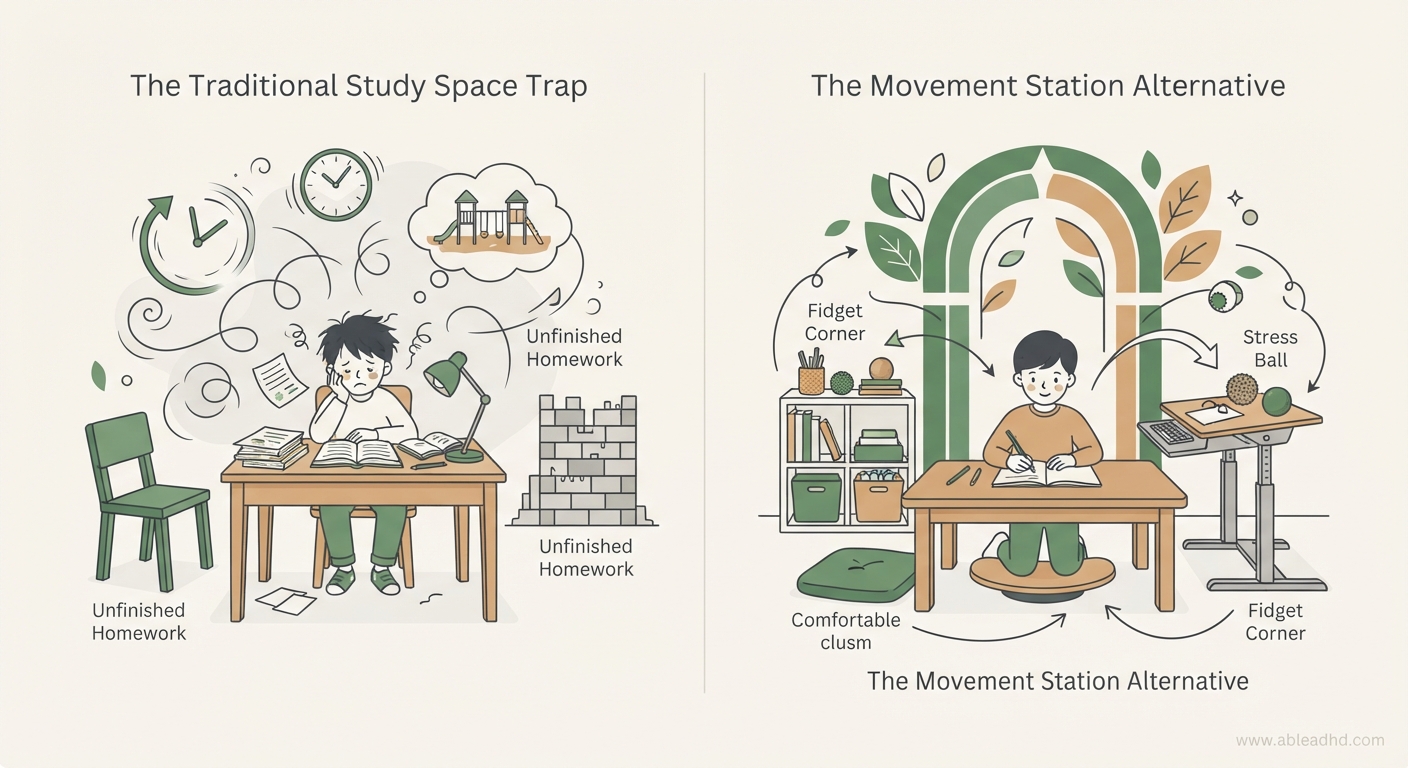
To reduce homework friction, we must abandon the notion that productivity requires a straight-backed chair and a silent room. Instead, we need to design environments that work with the neurobiology of the ADHD brain rather than fighting against it. We need to build Movement Stations.
Step-by-Step: How to Build a Movement Station at Home
Creating a movement station does not require a massive home renovation or expensive equipment. It requires shifting your perspective from containment to controlled kinesthetic output. Here is how to design a high-efficiency homework zone tailored for an ADHD brain.
1. Ditch the Standard Chair
The traditional four-legged wooden or plastic chair is public enemy number one for an ADHD student. Replace it with seating options that provide active vestibular feedback:
- Wobble stools or active-sitting discs: These allow micro-movements of the pelvis and core without requiring the child to leave the workspace.
- Exercise balls (with stability legs): Bouncing gently while reading or working provides rhythmic proprioceptive input that helps regulate the nervous system.
- Standing desks with footrests: Many kids with ADHD find standing vastly superior to sitting. Pair a standing setup with a textured balance board or a resistance band tied across the table legs for leg-bouncing.
2. Design for Multi-Sensory Alternation
An ADHD homework station should accommodate the reality of fluctuating attention spans. Instead of expecting sustained focus for 45 minutes straight, structure the space for dynamic intervals:
- The "Brain Break" Corner: Set up a small adjacent space with a mini trampoline, a yoga mat for deep-pressure bear crawls, or a space to do 10 wall-push-ups. Movement breaks should be built into the workflow proactively, not used as a punishment or a last resort when frustration peaks.
- Fidget Tool Architecture: Keep tools functional rather than distracting. Tactile inputs like stretchy bands on chair legs, textured desk strips, or weighted lap pads can provide the sensory grounding needed to anchor wandering thoughts.
3. Eliminate Environmental Cognitive Overload
While movement is necessary, visual and auditory clutter should be minimized. The movement station should allow for dynamic physical output while keeping the field of vision clean:
- Face the station toward a plain wall rather than a busy living room or a window with high-traffic outside views.
- Keep only the current assignment on the surface. Stash all other books, markers, and folders out of sight in color-coded bins.
- Use visual timers (such as a Time Timer) so the child can physically and visually see the duration of a work block ticking down, reducing time-blindness anxiety.
By reframing homework time around the physical needs of your child, you shift the dynamic from an exhausting nightly battle of wills to a collaborative, neuroscience-backed routine. When you stop fighting the wiggles, you unlock the brilliance beneath them.
References
- Rapport, M. D., Bolden, J., Kofler, M. J., Sarver, D. E., Raiker, J. S., & Alderson, R. M. (2009). Hyperactivity in boys with attention-deficit/hyperactivity disorder (ADHD): A ubiquitous core symptom or manifestation of working memory deficits? Journal of Abnormal Child Psychology, 37(4), 521–534.
- Sarver, D. E., Rapport, M. D., Kofler, M. J., Raiker, J. S., & Friedman, L. M. (2015). Standing in the way of productivity: Effects of mobility on cognitive performance in students with attention-deficit/hyperactivity disorder. Journal of Abnormal Child Psychology, 43(1), 73–86.
- Pontifex, M. B., Saliba, B. J., Raine, L. B., Picchietti, D. L., & Hillman, C. H. (2013). Exercise improves behavioral, neuroelectric, and cognitive performance in children with attention-deficit/hyperactivity disorder. The Journal of Pediatrics, 162(3), 543–551.
Tired of explaining your child’s ADHD to every teacher?
Upload your clinical diagnosis report and instantly generate a one-page, teacher-ready brief with evidence-based strategies in 2 minutes.
Create Your Free Teacher Brief →