
The Myth of the Chore Chart: What Actually Works for 5-10 Year Olds
Published by The Able Blog | Date: 2026-08-20
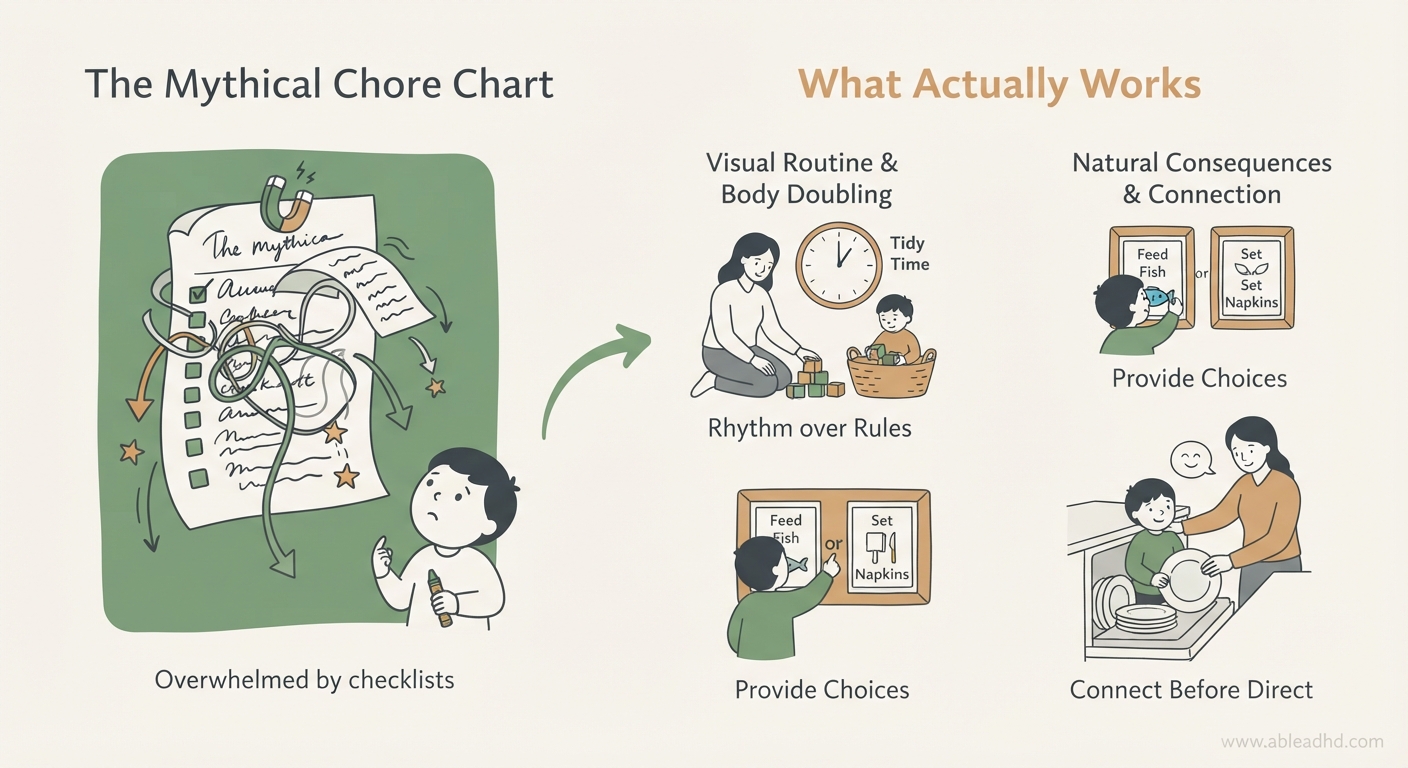
TL;DR
- Traditional chore charts rely on delayed rewards and consistent working memory, both of which are neurological pain points for children with ADHD.
- Shifting from external token economies to dopamine-friendly, immediate, and gamified systems drastically reduces daily household friction.
- Pairing tasks with environmental novelty, body doubling, and sensory engagement helps children aged 5 to 10 successfully build self-regulation skills.
The Anatomy of a Broken System: Why Charts Fail Neurodivergent Brains
Picture this: You spend Sunday night meticulously crafting a colorful chore chart for your seven-year-old. There are glittering star stickers, neat little checkboxes, and a promise of a weekend trip to the zoo if they earn twenty stars. Monday morning arrives. The child remembers the chart exists for precisely forty-two seconds, ignores it for the rest of the week, and by Thursday, you are staring at an empty grid, wondering why your child lacks basic motivation.
You are not failing, and neither is your child.
In clinical practice, parents often blame themselves when standard behavioral charts collapse. The reality is rooted in neurobiology. Children with Attention-Deficit/Hyperactivity Disorder (ADHD) experience an intrinsic dysregulation in how their brains process dopamine—the neurotransmitter responsible for motivation, reward anticipation, and goal-directed persistence.
Traditional chore charts rely heavily on two executive functions that are fundamentally impaired in ADHD: working memory (remembering the chart exists across time and space) and temporal processing (connecting a tedious chore now to a reward days or weeks later). To an ADHD brain, a reward promised next weekend simply does not exist.
The Dopamine Deficit in Daily Routines
When a neurotypical child hears, "Brush your teeth and put on your shoes," their brain releases a small baseline of dopamine that helps bridge the gap between boredom and execution. For a child with ADHD, routine transitions are physically painful because the brain perceives zero reward value in mundane tasks. Punishing them or removing stars from a chart doesn't fix a dopamine shortage; it only adds shame and emotional dysregulation to an already overwhelmed nervous system.
Building Dopamine-Friendly Frameworks for Ages 5-10
To bypass the executive function bottleneck, we must stop trying to change the child's brain and instead change the architecture of the environment. Here is how to swap rigid charts for systems that actively work with neurodivergence.
1. Gamification and Novelty
The ADHD brain thrives on novelty, competition, and urgency. Static lists become invisible within forty-eight hours. Instead of a static checklist, introduce game mechanics.
- The Beat-the-Timer Challenge: Instead of "clean your room," use a visual countdown timer (like a Time Timer) and say, "Let’s see if we can get all the red blocks into the bin before this disk disappears!" Play high-energy music to provide an external rhythm.
- The Mystery Box: Replace star accumulation with immediate, random-variable reinforcement. Pulling a tiny prize, a special sticker, or a voucher for "ten minutes of rough-housing with dad" out of a hat right after the task is completed creates a sharp, satisfying dopamine spike.
2. Body Doubling and Proximity
Expecting a 5-to-10-year-old with ADHD to independently initiate and sustain attention on a chore in an isolated room is setting them up to fail. Executive functioning is outsourced in early childhood; for ADHD kids, this period extends longer.
- Active Presence: Sit in the room while they clean. You don't have to do the work for them; your calm nervous system acts an external regulatory anchor.
- The Tag-Team Method: Break tasks down into micro-steps and alternate. "You put three books on the shelf, and I'll fold this one shirt. Ready, go!"
3. Visual and Spatial Cues
Words on a page require decoding and working memory. Leverage spatial awareness instead.
- Color-Coded Zones: Use colored duct tape on the floor to show where laundry baskets live, or match toy bin pictures directly to the toys inside.
- Task Striping: Instead of a full-page chart, use a single laminated strip showing just one current expectation (e.g., shoes on -> backpack on -> jacket on).
Fostering Independence Without the Guilt
Ultimately, our goal isn't to raise a child who can meticulously fill out a chore chart. Our goal is to raise an adult who understands how their unique brain functions and knows how to scaffold their own life.
When we abandon rigid, neurotypical behavioral molds, we open the door to connection and genuine skill-building. Celebrate the small victories, lower the bar on household perfection, and remember that an imperfectly finished room achieved with laughter and low stress is worth infinitely more than a pristine chart managed through tears.
References
- Barkley, R. A. (2015). Attention-Deficit Hyperactivity Disorder: A Handbook for Diagnosis and Treatment (4th ed.). Guilford Press.
- Centers for Disease Control and Prevention. (2024). Treatment of ADHD in Children. U.S. Department of Health and Human Services.
- American Academy of Pediatrics. (2019). Clinical Practice Guideline for the Diagnosis, Evaluation, and Treatment of Attention-Deficit/Hyperactivity Disorder in Children and Adolescents. Pediatrics, 143(4), e20192528.
Tired of explaining your child’s ADHD to every teacher?
Upload your clinical diagnosis report and instantly generate a one-page, teacher-ready brief with evidence-based strategies in 2 minutes.
Create Your Free Teacher Brief →