
The Playdate Blueprint: Setting Up Your ADHD Child (and Their Friends) for Success
Published by The Able Blog | Date: 2026-08-24
TL;DR
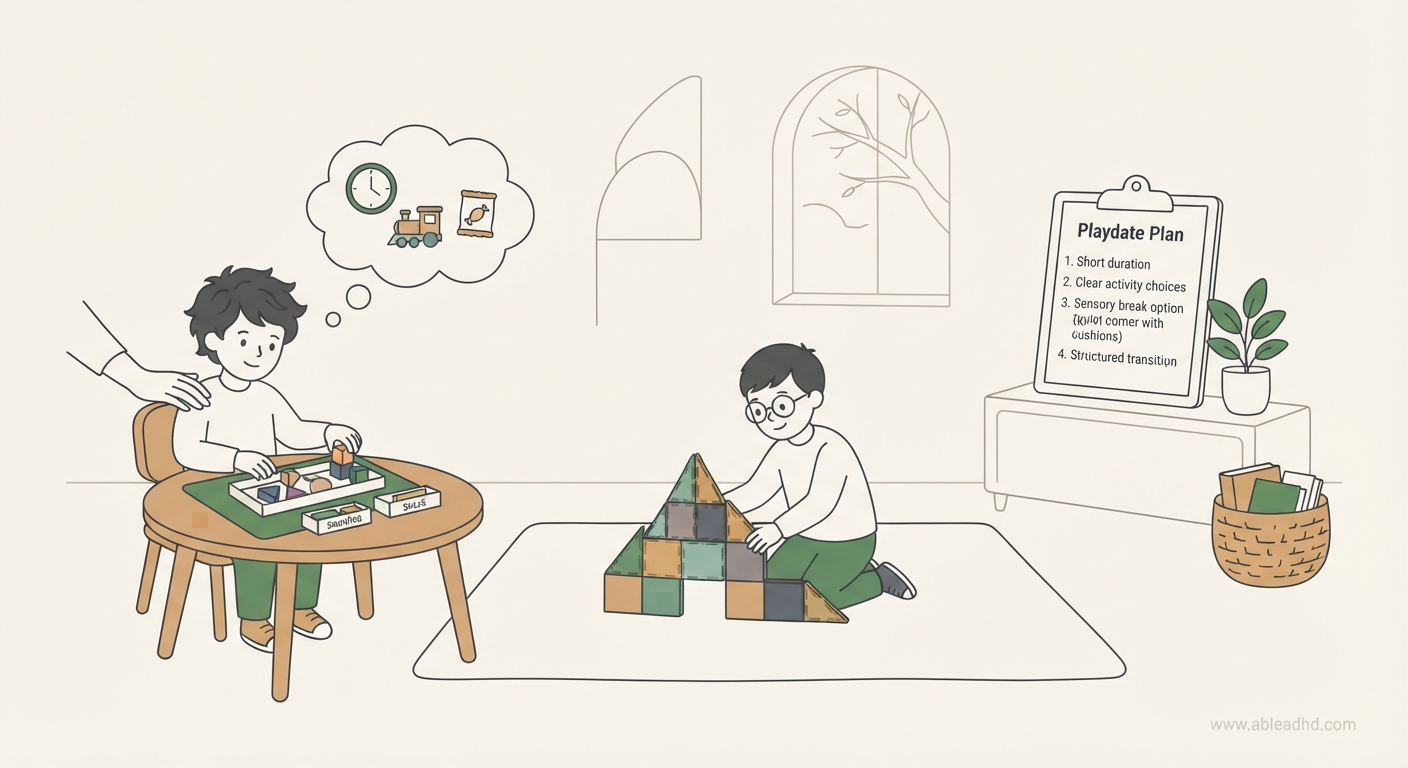
- Pre-empt the chaos: Keep playdates short (45–60 minutes) and structured around a high-engagement, low-conflict anchor activity rather than wide-open free play.
- Master the environment: Remove over-stimulating toys and set up safe "re-set" zones before guests arrive to prevent sensory overload and impulsivity spikes.
- Be the gentle buffer: Coach your child on sharing beforehand, and step in early as a calm, neutral mediator before emotional dysregulation peaks.
The Anatomy of an ADHD Playdate: Why Unstructured Time Triggers Friction
For many parents of children with Attention-Deficit/Hyperactivity Disorder (ADHD), the words "Can I have a friend over?" evoke a complicated mix of hope and dread. We want our children to build meaningful peer connections, practice social reciprocity, and experience the joy of shared play. Yet, we also carry the invisible weight of past playdates that ended in flying toys, hurt feelings, sudden meltdowns, and an exhausted, defensive child.
To understand why traditional playdates often derail, we have to look through a neurodevelopmental lens. Children with ADHD experience executive function differences, particularly in working memory, impulse control, and emotional regulation. When two or more kids are thrown into a room with zero structure, vague expectations, and an endless sea of toy choices, the cognitive load skyrockets. Without an external scaffold to guide them, a child with ADHD may struggle to read social cues, wait their turn during games, or modulate their physical energy.
The good news? Playdates do not have to be a high-stakes gamble. By shifting our approach from passive supervision to active, strategic scaffolding, we can create an environment where neurodivergent kids and their peers thrive.
Phase One: Preparation and Environment Design
Success on a playdate begins long before the doorbell rings. In fact, the most critical work happens during the pre-game setup.
1. Curate the Toy Landscape
When a child with ADHD walks into a playroom overflowing with thousands of pieces—Legos, action figures, board games, and craft supplies—decision fatigue sets in instantly. This paralysis of choice can spark frustration and erratic behavior.
- The Fix: Curate the environment beforehand. Put away high-conflict items (such as prized possessions, delicate collectibles, or toys that require complicated sharing rules). Leave out two or three specific, highly engaging activities that naturally invite parallel or cooperative play, such as an obstacle course kit, sidewalk chalk, or a structured building set.
2. Time Boxing for Success
Traditional playdates lasting three hours are often a recipe for disaster. By the second hour, dopamine reserves are depleted, physical fatigue sets in, and emotional dysregulation lurks just beneath the surface.
- The Fix: Keep early playdates intentionally brief—around 45 to 60 minutes. Ending a playdate while everyone is still having fun leaves a positive memory and prevents the inevitable crash. You can always say, "That was so much fun! Let's wrap up for today so everyone can rest, and we can definitely plan another playdate soon."
3. Prime the Child with Clear Expectations
Children with ADHD thrive on predictability. Surprises—even fun ones—can trigger anxiety and impulsivity.
- The Fix: Review the plan with your child 30 minutes before arrival. Use visual schedules or simple verbal roadmaps: "Leo is coming over at 3:00. First, you'll show him your comic books in the living room. Then, you'll have a snack in the kitchen. Finally, you can build with blocks until his mom picks him up."
Phase Two: Managing the Playdate in Real-Time
Once the guest arrives, your role transitions from host to benevolent guide. Your objective is not to hover, but to serve as an external emotional regulator.
Keep Activity Transitions Concrete
Unstructured transitions—such as moving from the backyard back inside—are notorious triggers for chaotic behavior and transition meltdowns. When it is time to switch activities, give a multi-step warning backed by a visual or auditory cue. Instead of yelling across the yard, walk over, make eye contact, and use a playful bridge: "Alright team, in five minutes we are landing the spaceship and heading inside for crackers and water."
Act as a Social Coach, Not a Police Officer
Peer rejection sensitivity and impulsive reactions can flare up quickly if a game rules dispute occurs. Rather than swooping in to punish or dictate a solution, coach the children through the problem-solving loop:
- Pause the action gently: "Whoa, I'm seeing some big frustrations with who gets to be the captain. Let's hit the pause button for thirty seconds."
- Validate both perspectives: "I know you both want the blue controller."
- Prompt collaborative problem-solving: "What is a fair way we can solve this so everyone gets a turn?"
Watch for the Early Warning Signs of Dysregulation
Every child has a unique physiological signature when they are crossing the threshold from excited to dysregulated. For one child, it might be an escalating voice pitch and manic giggling; for another, it is physical stillness, sulking, or rigid rule-enforcing. Intervene before the boiling point. If you notice your child entering the danger zone, initiate a quiet "reset break" for both kids. Offer a glass of cold water, a quick trip to the bathroom, or a quiet three-minute stretch of listening to an upbeat song.
By taking charge of the environment, keeping timelines manageable, and stepping in as a gentle emotional anchor, you transform the playdate from a stress-inducing trial into a joyful opportunity for genuine connection.
References
- Barkley, R. A. (2015). Attention-Deficit Hyperactivity Disorder: A Handbook for Diagnosis and Treatment (4th ed.). Guilford Press.
- Hinshaw, S. P., & Stier, A. (2008). ADHD, social skills, and peer relationships: Promoting positive socialization. Journal of Pediatric Psychology, 33(6), 555-568.
- Mikami, A. Y. (2010). The importance of friendship for youth with attention-deficit/hyperactivity disorder. Clinical Child and Family Psychology Review, 13(3), 234-250.
Tired of explaining your child’s ADHD to every teacher?
Upload your clinical diagnosis report and instantly generate a one-page, teacher-ready brief with evidence-based strategies in 2 minutes.
Create Your Free Teacher Brief →