
The 'Yes, And' Rule: How Playful Redirection Stops ADHD Power Struggles Before They Start
Published by The Able Blog | Date: 2026-10-12
TL;DR
- The Core Concept: Borrowing the "Yes, And" rule from improv comedy helps validate a child's ADHD-driven impulse rather than immediately blocking it, drastically reducing the neurological friction that leads to meltdowns.
- The Brain Science: Children with ADHD experience delayed prefrontal cortex development and a heightened sensitivity to perceived threats; rigid parental "no's" instantly trigger a defensive fight-or-flight response.
- The Action Plan: Acknowledge what your child wants to do (Yes), accept the emotional reality of their impulse, and playfully reframe the next step (And), turning resistance into cooperative momentum.
The Anatomy of an ADHD Power Struggle
Picture this: It is 7:15 AM. You have asked your seven-year-old with ADHD to put on their shoes for the fourth time. Instead of complying, they are currently belly-crawling across the living room rug, roaring like a velociraptor. You feel the familiar, white-hot prickle of frustration rising behind your sternum. You take a breath, use your firmest parenting voice, and say, "We don't have time for dinosaurs right now. Put your shoes on immediately."
What happens next? Often, an explosion. Total gridlock, screaming, or a full sensory meltdown.
As pediatric clinicians and parents, we frequently view these moments as behavioral defiance. However, through the lens of modern neurobiology, what looks like stubborn opposition is actually a neurological traffic jam. Children with Attention-Deficit/Hyperactivity Disorder (ADHD) live with a chronic shortfall of dopamine—the neurotransmitter responsible for motivation, focus, and reward processing. Their brains are constantly hunting for stimulation. When a child is deep into a dinosaur crawl, their nervous system has found that dopamine hit. When you drop a heavy, rigid "No" or a strict command on them, you aren't just giving an instruction; you are abruptly severing their neural dopamine supply line.
To a nervous system that struggles with emotional regulation and cognitive flexibility, a direct parental veto registers as an existential threat. The amygdala hijacks the brain, and the child instantly enters a fight-or-flight state. They dig their heels in. You dig yours in. The power struggle is officially born.
To stop fighting the neurodivergent brain, we have to learn to surf its waves. That is where the improvisational comedy stage meets the family living room.
The Improv Secret: Stepping Into Their Reality
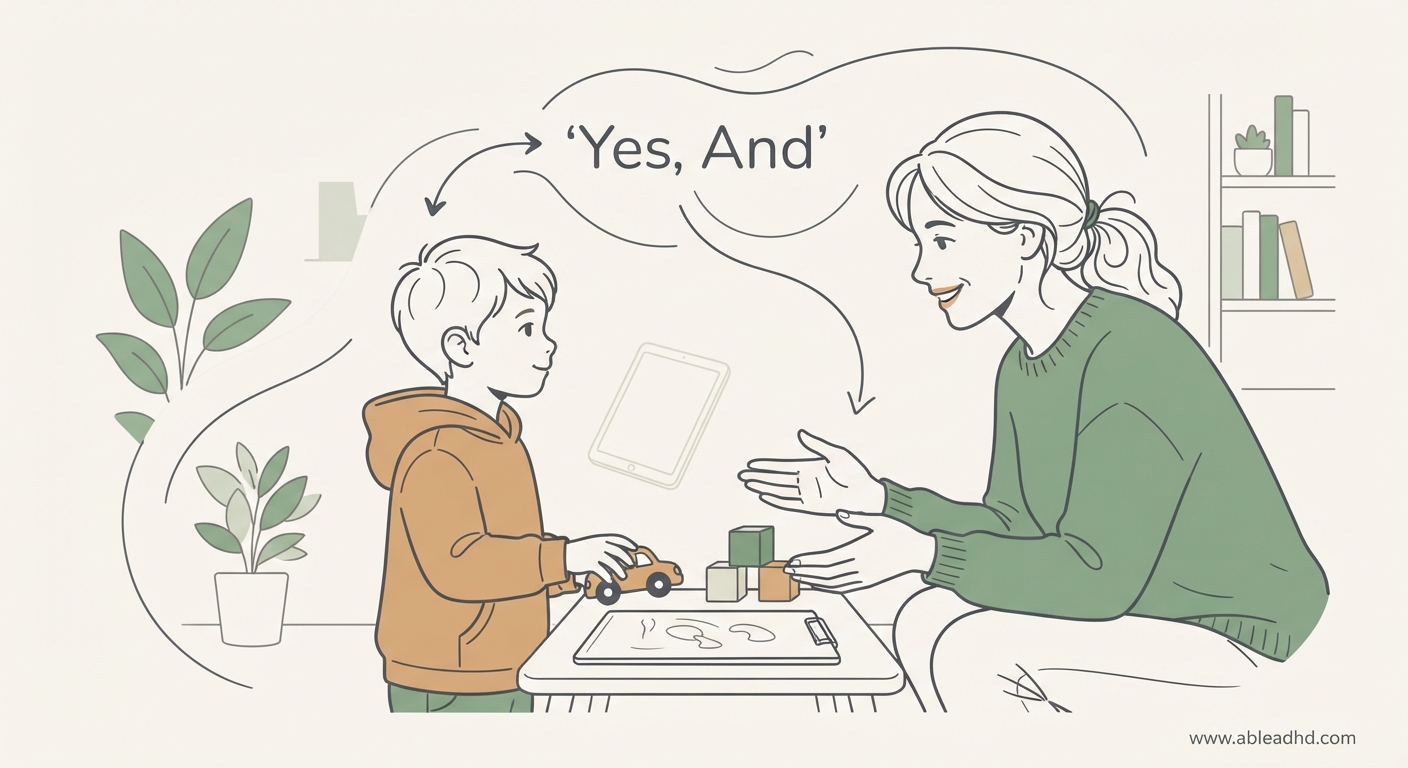
In improvisational comedy, performers live by a golden rule: "Yes, And." When an improv actor throws a bizarre premise at their scene partner—such as, "Look out, the floor is made of invisible peanut butter!"—the worst thing the partner can do is block it by saying, "No, it isn't." That instantly kills the scene, shuts down creativity, and creates a dead end. Instead, the actor must accept the reality ("Yes, the floor is sticky!") and build upon it ("And my socks are ruined, so we better swim across!").
Children with ADHD are master improvisers living in a world designed for rigid scripts. When we meet their impulsive, hyperactive, or distractible behavior with an automatic "No," "Stop," or "Hurry up," we are blocking their scene.
Playful redirection uses the "Yes, And" framework to bypass the child's defensive alarm system. It involves two vital steps:
- "Yes" (Validation): Acknowledge the impulse, the energy, or the fun of what they are doing without endorsing rule-breaking. You validate the feeling or the fantasy, which instantly lowers their defensive shields.
- "And" (Redirection): Pivot the high-energy momentum toward the required task by matching their playful state.
Why Playful Redirection Works
When you use play, humor, or theatrical exaggeration, you tap into the social-engagement system of the autonomic nervous system. Dopamine and oxytocin are released. The child’s brain realizes, Oh, we aren't in a battle; we are in a game.
Furthermore, children with ADHD possess a relative strength in divergent thinking and imagination. By engaging their creative mind instead of shutting it down, you reduce cognitive load and work with their neurobiology rather than against it.
Putting 'Yes, And' Into Action: Scripts for Daily Friction
Transforming this concept into daily routines does not require you to be a stand-up comedian. It simply requires a willingness to temporarily step into your child's imaginative world. Here is how to apply the "Yes, And" rule to three of the most common ADHD pain points.
1. The Transition Trap (Leaving the House or Turning Off Screens)
- The Old Way: "Turn off the tablet right now or we are leaving without you!" (Result: Screaming, crying, device clinging).
- The "Yes, And" Way: "Yes, this level of Super Mario is wildly epic, and Bowser is definitely trying to ruin your day! And since we are secret ninja agents, we have exactly 60 seconds to execute a stealth roll to the front door before the video game security guards catch us. Go!"
- Why it works: You validated their immersion in the game instead of dismissing it, and you transformed the boring, frustrating act of stopping into a high-stakes mission that triggers dopamine.
2. The Chore Resistance (Cleaning Up Toys)
- The Old Way: "Your room is a disaster zone. Clean it up before you do anything else." (Result: Overwhelm, paralysis, staring blankly at the mess).
- The "Yes, And" Way: "Yes, these Lego bricks have completely taken over the rug and they are throwing a massive dance party! And the dance party has to move into the toy box right now, or the toy box monster will eat them all. Quick, feed the monster the blue blocks first!"
- Why it works: ADHD brains often experience executive dysfunction paralysis when faced with an unorganized, massive task. Playful framing breaks the overwhelming chore into bite-sized, gamified chunks.
3. The Emotional Meltdown (Dopamine Crash and Defiance)
- The Old Way: "Stop yelling at me and use your inside voice or you are going to time-out." (Result: Escalation, hitting, throwing objects).
- The "Yes, And" Way: "Yes, you are so mad your head feels like it's about to shoot rocket fire into space! And since we are astronauts on a wild rocket ship, let's take three massive, deep space-breathing cycles together right now so our engine doesn't overheat."
- Why it works: You are labeling and validating their intense emotional state without judgment (the "Yes"), which co-regulates their nervous system, followed by a somatic, movement-based calming technique (the "And").
By trading rigid control for playful collaboration, you stop fighting your child's brain and start guiding it. You become less of an adversary barking orders, and more of an enthusiastic director helping them star in their own success story.
References
- Barkley, R. A. (2015). Attention-Deficit Hyperactivity Disorder: A Handbook for Diagnosis and Treatment (4th ed.). Guilford Press.
- Porges, S. W. (2011). The Polyvagal Theory: Neurophysiological Foundations of Emotions, Attachment, Communication, and Self-Regulation. W. W. Norton & Company.
- Greenspan, S. I., & Wieder, S. (2006). Engaging Autism: Using the Floortime Approach to Help Children Relate, Communicate, and Think. Da Capo Lifelong Books.
Tired of explaining your child’s ADHD to every teacher?
Upload your clinical diagnosis report and instantly generate a one-page, teacher-ready brief with evidence-based strategies in 2 minutes.
Create Your Free Teacher Brief →