
Unpacking the 'Imaginative Mess': Why ADHD Kids Create Elaborate Worlds (And How to Clean Up Without Crushing Their Creativity)
Published by The Able Blog | Date: 2026-09-07
TL;DR
- The Brain Science: Sprawling, immersive play is a natural manifestation of divergent thinking, hyperfocus, and sensory-seeking behavior common in ADHD brains.
- The Emotional Cost: Abruptly dismantling an elaborate play world ("clean your room now!") can feel like an aggressive invalidation of deep cognitive investment and emotional labor to a child with ADHD.
- The Solution: Transition to low-conflict systems—such as designated "construction zones," photographic preservation, and boundary-based clean-up rituals—that protect their creativity while restoring family sanity.
The Architecture of Chaos: Inside the ADHD Imaginative Mind
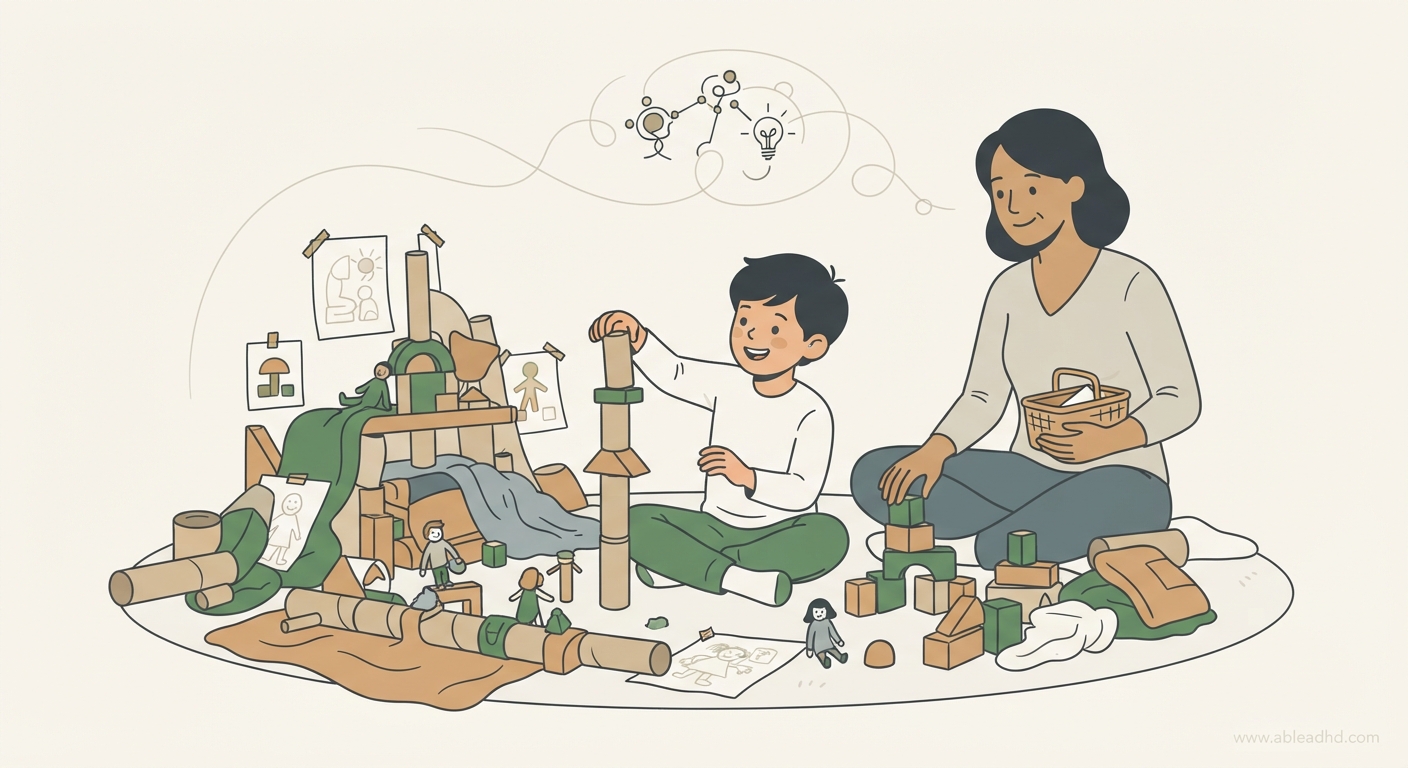
Picture this: You walk into your living room. A sofa cushion fortress spans the floor, connected to a maze of cardboard boxes, magnet tiles, and stuffed animals arranged in a rigid, highly specific social hierarchy. Half-built Lego spaceships share terrain with a stuffed bear kingdom. You have reached the epicentre of the ADHD imaginative mess.
For many parents, stepping into this zone triggers an immediate stress response. It looks like disorder, clutter, and a monumental chore waiting to happen. But as clinicians, when we look at this sprawling landscape through a neurodiversity-affirming lens, we see something entirely different: a masterpiece of divergent thinking, deep-dive hyperfocus, and executive function in action.
Children with ADHD often process the world through a lens of high stimulus-seeking and boundless imagination. Where a neurotypical child might build a quick block tower and knock it down, a child with ADHD builds an entire socioeconomic ecosystem complete with complex lore, rules, and continuity. This is not random mess; it is externalized executive functioning. Because working memory—the mental scratchpad—can be a bottleneck for ADHD kids, they use their physical environment as an external hard drive. Every prop, pillow, and toy has a designated place in a vast, unfolding narrative.
Why Executive Dysfunction Makes "Cleaning Up" Feel Like an Emergency
When a parent says, "Time to clean up this disaster," the neurotypical expectation is that the child will systematically dismantle the project and put pieces away. However, for a child with ADHD, this command triggers a cascade of neurological friction:
- Task Paralysis: The sheer volume of visual stimuli makes it impossible to know where to start, leading to freezing or meltdowns.
- Emotional Attachment: Because the play world represents hours of intense cognitive immersion and emotional regulation, destroying it feels akin to burning an artist's canvas mid-stroke.
- Time Blindness: To an ADHD child, taking apart the world means erasing the future where they planned to continue playing tomorrow.
Recognizing that this mess is actually an act of creation changes how we respond. Instead of fighting the mess, we can learn to manage the transition from play to order without breaking our child's spirit.
Practical Systems to Protect Creativity and Restore Your Living Room
You do not have to choose between a pristine home and a creative child. By implementing environment-first design and low-conflict transition rituals, you can drastically reduce the friction of cleanup time.
1. Establish Permanent "Construction Zones"
Containment is the secret weapon of ADHD parenting. Trying to keep the entire house clear of imaginative play sets families up for daily conflict.
- Designate a Sanctuary: Dedicate a specific corner of a bedroom, a basement area, or a designated low-traffic zone as the "Mega-Project Zone."
- Use Visual Boundaries: Lay down a large area rug or use painter's tape to mark the perimeter. The rule becomes: The world can be as big as you want, as long as it lives inside the borders. Once play spills out into the main walkways, it is time for a reset.
2. The "Museum Curator" Strategy (Preservation Before Destruction)
When a sprawling world must be cleared away because guests are coming over or the space is needed, never force an immediate teardown without a bridge.
- Take a Snapshot: Treat your child like a museum curator. Before any blocks are moved, take a photo or a short video walk-through where your child narrates the current state of their world.
- Validate the Work: Say, "This base looks incredible. We need to clear the floor for dinner tonight, but let's take a picture so we can rebuild it or remember this chapter tomorrow." This validates their emotional investment and provides a blueprint for future play.
3. Chunked Cleanup with Body Doubling
Telling an ADHD child to "go clean your room" is like telling someone to build a bridge across the Atlantic using a teaspoon. It is too vague and overwhelming.
- Body Double: Sit in the room with them. Your calm, focused nervous system acts as an external regulator for theirs.
- Micro-Categorization: Instead of sorting everything at once, run a themed sweep. "Round one: All blue blocks into the bin. Ready, set, go!" Turn the physical movement into a game or set a fun, upbeat song to play while working together.
Fostering Independence Without Friction
Ultimately, teaching an ADHD child to manage their own environment requires patience and systems built for their brain, not against it. Open-faced bins, picture labels, and floor-level storage work infinitely better than closet shelves with doors.
When we stop viewing their elaborate worlds as inconveniences and start viewing them as laboratories of innovation, we teach our children a vital lesson: their big, wonderfully chaotic minds are safe, valued, and understood right inside our homes.
References
- Barkley, R. A. (2015). Attention-Deficit Hyperactivity Disorder: A Handbook for Diagnosis and Treatment (4th ed.). Guilford Press.
- Brown, T. E. (2013). A New Understanding of ADHD in Children and Adults: Executive Functionsal Impairments. Routledge.
- Siegel, D. J., & Payne Bryson, T. (2012). The Whole-Brain Child: 12 Revolutionary Strategies to Nurture Your Child's Developing Mind. Delacorte Press.
Tired of explaining your child’s ADHD to every teacher?
Upload your clinical diagnosis report and instantly generate a one-page, teacher-ready brief with evidence-based strategies in 2 minutes.
Create Your Free Teacher Brief →